 |
| Delayed Birth Certificate |
My grandmother Anna Pereksta was born 10 March 1895 in the remote Carpathian mountain village of
Príslop, then located in Zemplén County, Hungary. Today Príslop is in the far northeastern corner of Slovakia about 8 kilometers as the crow flies from the Polish border. It was a very small, almost entirely Greek Catholic village with a population of only 159 people in 1914.
Anna was the sixth of eight children born to Ivan Pereksta and his wife, Olena Sidor (Hocko). When she was a young child
her father, older brothers and sisters went to the United States to work. Her father would be gone several years at a time, returning home for a year or two and then returning to U.S. for work. Her mother worked their small plot of land. Food was sometimes scarce. Their home was shared with their farm animals. Little formal education was available.
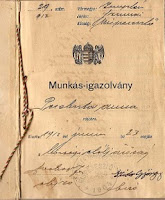 |
| Hungarian passport |
Life could also be challenging in the U.S. for the emigres. Anna's eldest sister, married with a child and expecting a second, was unhappy in the U.S. and returned to Príslop. However, after several months of working in the fields, she opted to return to the U.S. When Anna turned 18 she emigrated to the United States arriving at Ellis Island aboard the
Amerika with her father on 13 July 1913. They were held overnight until her sister Susanna arrived from Binghamton, NY. She never returned to Europe, never saw her mother, younger sister or two brothers again.
Anna lived with her sister Sue in Binghamton and then, following Sue's marriage in 1914, with her sister and brother-in-law. She went to work as a stitcher at an
Endicott-Johnson (EJ) shoe factory and remained there until her marriage almost a decade later. In the early 1920s, as her sister's family grew, she moved to live with one of her Sedor cousins (her mother's nephews). She and her cousin George Sedor were both ill for a considerable time and recuperated at a sanitarium in Saranac Lake (which is where, I believe, the above picture was taken). By the end of 1922 she had moved to her friend Mrs. Dunda's boarding house. Mr. Dunda was a leather cutter at EJs. His wife took in boarders to bring in extra money.
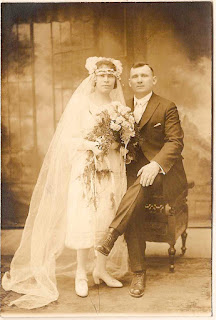
Anna had been unwilling to marry, prizing her independence. But in the winter of 1923, when she was 27 years old, she met Stefan Papp (Stephen Popp), a 40 year old leather cutter working at EJs. They met on the street while she was walking with a friend who was from the same village Stefan had emigrated from two years earlier. He could not take his eyes off her and showed up at Mrs. Dunda's door the next evening. Anna, wet and bedraggled from trudging home in the snow, was sitting by the stove when he arrived. He asked her to a movie the following Saturday and, with her friend emphatically nodding yes, Anna agreed. He asked her to marry him that Saturday, explaining that he was ready to marry and raise a family. She was more than a little dumbstruck, but Mrs. Dunda and her sisters encouraged her to agree and she did. It may be the only impulsive move she ever made, but it was a good decision.
 |
| Church Marriage Record |
His cousin was a priest in Indiana and Stefan suggested they go there to marry, but Anna wanted to be married in Binghamton where her family and friends were. After a whirlwind courtship they married on 17 Feb 1923 at St. Michael's Greek Catholic Church only a few weeks after they met.
Anna's story is continued
here.


